
Let’s Talk Social Security Facts, Not Fear
Recent headlines may be misleading you.
Article published: December 03, 2025

Lately, social media influencers have embraced what politicians have long known: To get attention, talk about Social Security.
Whether you’re seeing headlines and posts claiming Social Security will run out of money (it won’t), will stop being taxed (nothing but a campaign idea at this point) or will just plain end as a program (highly unlikely), you can be pretty sure they’re trying to draw you in, not help you.
These headlines may be right about one thing, though: You should be strategic about claiming Social Security. It’s one of your best chances to help optimize your financial security in retirement. Having a thoughtful plan – based on reality, not rumors – is critical. Because once you claim, it’s hard or impossible to undo.
WHAT’S REALLY HAPPENING WITH SOCIAL SECURITY
Before we get to strategies, let’s look at the landscape. The money for Social Security payments currently comes from two places: most of it from the Social Security payroll taxes constantly being collected from people still working, and the rest from a “trust fund” that holds all the excess tax money that was collected over decades and not needed to cover benefits.
For several years now, Social Security has been drawing down that trust fund because it needs to pay out more than it’s taking in via Social Security taxes. In a nutshell, younger generations are having fewer children, and the number of American workers can’t fully support the older generations – who are also living longer – and who have retired and started collecting.
But the trust fund will eventually run out, and somewhat soon – the latest estimates are that the trust fund will last about seven to eight more years.
So what happens in 2033? Without the trust fund, Social Security can only pay out what it takes in, meaning benefits would fall to about 75%-80% of their current level.
This isn’t news; We’ve known about it for a long time. But the closer it gets, the more headlines you’ll see about it.
And yes, it got a little bit worse this year, for a couple reasons:
- Some people are now eligible for higher benefits as the result of legislation enacted in January
- The new senior deduction and other tax changes created under the One Bill Beautiful Bill Act will reduce taxable income for many older Americans, the effects of which will slightly decrease the amount going into the Social Security trust fund
That said, eight years is a long time in politics. There are several things that could happen to counter the looming shortfall. And to be clear, we do think that at some point, some kind of action will be taken.
To reduce benefits paid out:
- The penalty for filing early could be increased
- The benefit for filing later could be decreased
- The ways benefits are reduced if you’re still working, cost of living adjustments are calculated or overall benefits are calculated could be adjusted
- The Full Retirement Age (currently 67) could be increased
- The earliest age you can claim (currently 62) could be increased
To increase taxes coming in:
- The Social Security wage base (the amount of wage income that has Social Security tax applied to it, currently $176,100) could be increased
- The Social Security wage tax rate (currently 12.4%) could be increased
FOMO ISN’T A STRATEGY
It’s human nature to want to deal with uncertainty by taking action. And there’s some evidence that concerns over the future of Social Security are leading to a rush of new, early applications. In fact, we’ve had quite a few clients ask about filing for benefits ASAP “just in case.”
Changing your plans just in case something happens is almost never a strategy we would endorse. One thing that’s certain is that if you claim benefits early, you’ll lock in a lower benefit payment for the rest of your life. And that will still be true even if action is taken to correct the shortfall and it never comes to pass.
Here are three actual ways to be strategic:
- Plan for a range of scenarios and remain flexible
- Plan based on your own needs and cost/benefit analysis
- Take action based only on what is known to be true
Let’s look at an example.
THE MATH BEHIND YOUR SOCIAL SECURITY DECISION
For a lot of people, waiting to file for Social Security gives them the highest overall benefit. That becomes truer the longer that lifespans increase. Here’s the math:
For every year you wait past Full Retirement Age (up to age 70), your benefit grows by about 8%. Conversely, if you file early, your benefits will be reduced by an average of 6% a year, with the highest penalization from ages 62-65. It adds up to 30% overall if you file at the earliest possible date.
So while claiming early gives you a “head start” on collecting money, by your early 80s, that advantage will be wiped away, and from that point forward, you would have been better off waiting.
“If we knew when you were going to die, the decision on when to take Social Security would be easier,” says financial planner Ron Sisk. “Since we don’t, we have to decide: Do you go for more checks with a lower amount, or fewer checks with a higher amount? Assuming you live at least a normal lifespan, often fewer checks with a higher amount gives you more money ultimately.”
The age you start has a lifetime impact
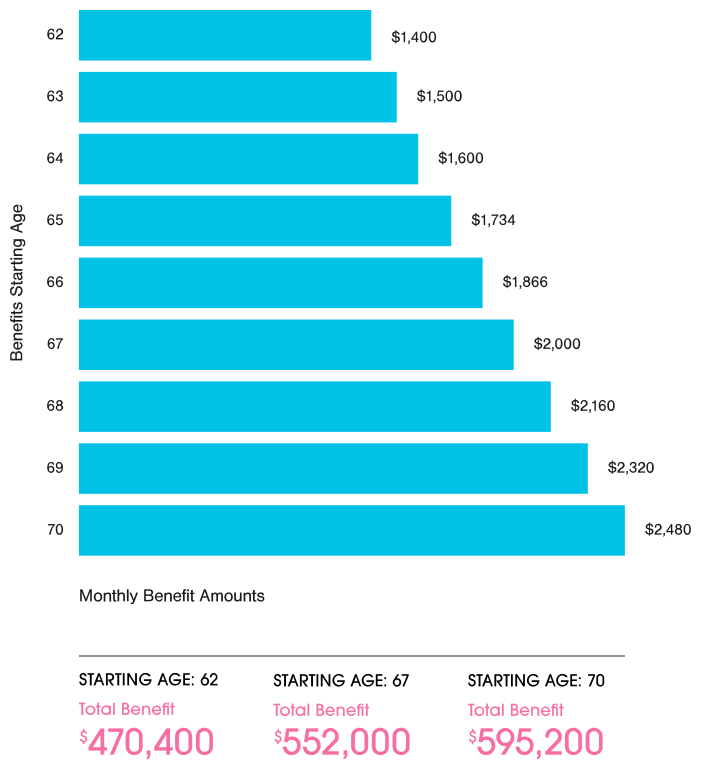
Source: Social Security Administration and Edelman Financial Engines. Assumes a $2,000 benefit at a Full Retirement Age of 67 and that you live until age 90.
There are a couple of other points you should take into consideration as well:
- The benefit you start with is the benefit that all future cost-of-living increases will be applied to. In our example in the chart above, the difference between claiming ASAP and at FRA is “only” $7,200 a year ($600 x 12 months). But after 20 years of hypothetical 2% COLA increases, that difference would be nearly $10,500 a year (in nominal dollars), and it would continue growing.
- If you’re married, you should also take that into account, because a higher benefit from waiting would also apply to any survivor benefits they receive if you pass away first. So you don’t necessarily need to personally live to a ripe old age for waiting to be the best strategy.
LOOK AT YOUR NEEDS
Obviously, if you need the benefits in order to survive, you should collect them. That’s why they’re there. But many of our clients are in the position of being able to decide where to take income, and when (Social Security vs. retirement savings withdrawals, for example).
And looking at your needs is an exercise that you can do continuously once you hit age 62. If you don’t take Social Security right away, that doesn’t mean you have to wait until FRA or beyond. You can start at any time if your situation – or the rules about Social Security – change.
“You don’t have to think about it as a big decision to ‘wait to take Social Security for six to eight more years,’” Ron says. “Every month you wait makes your benefit a little higher. You can think of it as just deciding not to start this month.”
As you’re doing this analysis, remember that waiting to take Social Security may mean you have to take larger withdrawals from your savings early in retirement. That might feel uncomfortable. But it also means that a lot more of your needs can be covered by (inflation-adjusted) Social Security payments later in retirement, significantly reducing the need for those withdrawals.
MAINTAINING FLEXIBILITY IS KEY
As we said above, claiming Social Security early just because you’re afraid is kind of like panic selling at a loss: It potentially just locks in a worse financial outcome.
It doesn’t even do what all the recent early claimers might be hoping for. Because (1) changes are likely to be made to mitigate the shortfall anyway, and (2) any changes to claiming requirements are unlikely to be applied based on whether you’re already collecting Social Security. They’ve previously been based on birth year and are likely to apply to younger generations, not current retirees.
YOUR PLANNER IS HERE TO HELP
We understand why Social Security is such a charged topic and why you might prioritize getting as much as you can, as soon as possible. After all, you worked hard and paid into it for decades, and it’s your money owed back to you. We want you to have it, too.
But Social Security isn’t going to vanish overnight, so there’s no need to change your plans on the basis of rumors or fearmongering headlines.
Your Social Security strategy, like your overall financial plan, should be highly personal. Your financial advisor can help you weigh health and longevity factors, income needs, your spouse’s claiming strategy and tax implications. And they’ll be here to guide you if and when anything changes, to help you get the most out of it.
This material was prepared for educational purposes only. Although the information has been gathered from sources believed to be reliable, we do not guarantee its accuracy or completeness.
Neither Edelman Financial Engines nor its affiliates offer tax or legal advice. Interested parties are strongly encouraged to seek advice from your qualified tax and/or legal professionals to help determine the best options for your particular circumstances.
AM4971763


